
Becoming a Frontier Firm: What It Really Takes

The future belongs to frontier firms – organisations that blend human ingenuity with the scale, speed, and precision of AI. But what does it really take to become one?
Defining the Frontier Firm
A “frontier firm” is not just a business with advanced technology. According to Microsoft’s 2025 Work Trend Index, it’s an organisation built around “intelligence on tap,” where hybrid teams of humans and AI agents operate with agility, scale rapidly, and unlock new value. These firms are outcome-driven, not bound by rigid hierarchies, and are powered by a new role for everyone: the “agent boss” – employees who orchestrate and manage AI agents to deliver results.
The Transformation Journey: Three Phases
Microsoft’s research and Xpedition’s own journey outline three phases to becoming a frontier firm:
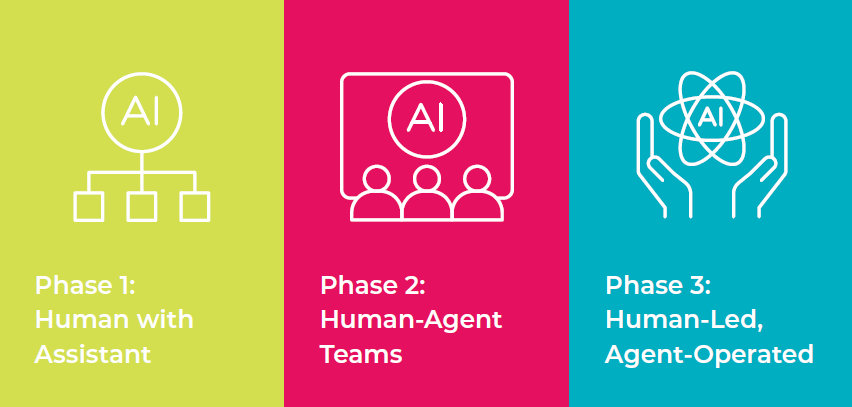
Human with Assistant: AI acts as a digital assistant, removing repetitive tasks and freeing people to focus on higher-value work. This phase is foundational and already reshaping operations at Xpedition, with Copilot saving over 1,000 hours in six months across meeting summaries, content generation, and admin tasks.
Human-Agent Teams: Agents evolve from passive assistants to active digital colleagues, taking on specific tasks under human direction. In Xpedition’s CRM practice, GitHub Copilot acts as a virtual team member, accelerating code reviews and streamlining delivery timelines. This shift is tangible across Financial Services, Fashion, and Retail, where AI is shortening time-to-value and elevating the role of consultants.
Human-Led, Agent-Operated: The future sees agents operating autonomously within defined parameters, while humans retain leadership over outcomes, innovation, and trust. By 2026, agent orchestration will be a core consulting skill, with delivery timelines shortening and new career paths emerging around agent management and AI strategy.
Microsoft’s 2025 Work Trend Index
AI adoption is accelerating: 82% of leaders say this is a pivotal year to rethink strategy and operations, and 81% expect agents to be moderately or extensively integrated into their company’s AI strategy in the next 12–18 months.
Productivity and capacity gap: 53% of leaders say productivity must increase, yet 80% of employees report lacking the time and energy to meet rising expectations. AI is seen as the lever to close this gap, with 46% of organisations already deploying AI agents in customer service, marketing, and product development.
Agent bosses are becoming critical: The rise of agent bosses – employees who train and manage AI tools as part of their role – is a key workforce trend. However, a readiness gap persists, with 67% of leaders feeling familiar with AI agents, compared to just 40% of employees in the wider business. Success hinges on empowering human-agent teams with the right skills and oversight.
Xpedition as your strategic guide
Xpedition’s Customer Zero approach means adopting and testing Microsoft’s latest innovations internally before bringing them to clients. With a 95% Copilot adoption rate and over 2,000 intelligent recap actions each month, Xpedition is living the transformation it guides others through.
The Human-AI workforce
The journey isn’t about replacing people – it’s about amplifying them. Human consultants bring strategic thinking, empathy, and expertise, while AI agents deliver tireless execution and precision. The most successful frontier firms will be those that empower employees to become agent bosses – able to direct, monitor, and optimise multiple agents with confidence.
Ready to become a frontier firm?
Explore the full whitepaper for a deeper dive into Xpedition’s journey, practical frameworks, and actionable insights:
Download the Hybrid Workforce of the Future Whitepaper
Or start your journey with Copilot START